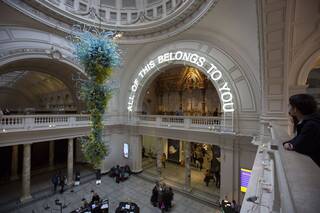
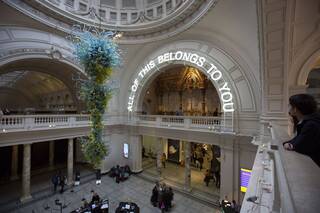
The Victoria & Albert Museum (V&A) and the Germanisches Nationalmuseum (GNM) are collaborating to organise a pair of conferences exploring the relationship between museums’ histories and their future missions. This first conference examines how large-scale museums with national remits can critically engage with their own institutional pasts to inform their present-day identities and considers how these institutions can contribute to fostering social cohesion in increasingly diverse twenty-first-century societies.
Focusing on the formation, interpretation, and display of national collections, the conference takes as its point of departure a range of major museums and memory institutions founded or fundamentally reshaped amid the political and historical transformations of the nineteenth and twentieth centuries. Bringing together an international group of scholars and museum professionals, it explores how these institutions have shaped—and been shaped by—changing ideas of nationhood, identity, empire, and public responsibility.
Speakers will address questions including:
- How were museum profiles and their claimed roles in society continually redefined throughout the nineteenth and twentieth centuries?
- How did museums communicate ideas of nationhood, nationalism, and imperialism within changing political and intellectual contexts?
- How have museum professionals in the twentieth and twenty-first centuries sought to confront historical legacies in order to redefine, stabilise, and legitimise their institutions' missions?
Conference Programme (provisional)
Thursday, 22 October 2026
14.00–14.30 Registration and refreshments
14.30–14.45 Institutional welcome
14.45–15.15 Introduction (Joachim Berger, Darja Jesse and Simona Valeriani)
15.15–16.45 Panel 1: Legacies: museums, empires and the postcolonial
Chair: Richard Espley (V&A)
Damiana Oțoiu, University of Bucharest (Romania)
The Nation in the Museum: Postcolonial Collections and Repatriation Debates in the Democratic Republic of Congo (1970–today)
Diệu Ly Hoàng, University of Oxford (Oxford, UK)
Collecting the Nation under Colonial Rule: The Musée Khai-Dinh in Vietnam
Ewa Manikowska, Institute of Art Polish Academy of Sciences (Warsaw, Poland)
Restitution and the Making of National Museums after 1918: The Polish–Soviet Case
16:45 Day 1 ends
Friday, 23 October 2026
10.15–11.45 Panel 2: Art collections and the construction of national identities
Chair: Diana Unterhitzenberger (GNM)
Kamila Kłudkiewicz and Aldona Tołysz, Adam Mickiewicz University (Poznań, Poland) / Office of the Provincial Conservator of Monuments in Warsaw (Poland)
The Strategy of a Young State on the Periphery of Europe. The Establishment of a National Museum in Poland during the Interwar Period
Marie Tavinor, The Royal Academy of Arts (London, UK)
Doubling Size and Changing Remit: the Tate Gallery’s Shift from National to International Collection in the 1920s
Ulrike Müller, University of Antwerp (Belgium); Royal Museums of Fine Arts of Belgium, Brussels
From National Monument to Museum Satellite: The Meunier Museum and the Contested Notion of Nationhood in Belgium
12.00–13.30 Panel 3: Reinterpreting objects in transnational encounters
Chair: Darja Jesse (GNM)
Susanne Boersma, Centre for Regional History (Brixen/Bressanone, Italy)
The Significance of the Hindeloopen room: A Transnational History through Provenance, Museum Strategies and Practices
Azar Emami Pari, Kunsthistorisches Institut in Florenz (Italy)
Persia in Fragments: Safavid Carpets and the Museum Imagination
Iñigo Salto Santamaría, Universität Zürich (Switzerland)
Weaving Histories of Deaccession in the 1930s: A Byzantine Textile between Düsseldorf and London
13.30–14.45 Lunch
14.45–16.45 Panel 4: Delimiting the nation and negotiating multiple belongings
Chair: Simona Valeriani (V&A)
Stefanie Jovanovic-Kruspel, Natural History Museum Vienna; University Vienna (Austria)
Re-reading the Naturhistorisches Museum Vienna: Revising Architectural and Curatorial Narratives
Gerrit Verhoeven, University of Antwerp (Belgium) / Royal Museums of Art and History, Brussels (Belgium)
Belgique Ancienne: Antoine Schayes and the Collection of National Archaeology in Brussels (1835–1859)
Patricia Allerston, National Galleries of Scotland (Edinburgh, UK)
National Baggage: The National Gallery of Scotland’s ‘on-off relationship’ with its Scottish collection, c. 1920─2020
Christopher Wilk, Performance, Furniture, Textiles & Fashion Department, V&A, Creating the V&A’s British Galleries 1500-1900 during an era of UK devolution and fervid Euroscepticism
16.45–17.15 Coffee/Tea
17.15 Day 2 ends
Museum stays open until 22:00
Saturday, 24 October 2026
10.15-12.15 Panel 5: Shaping national profiles through multilateral collaboration and conflict
Chair: Joachim Berger (GNM)
Susanna Avery-Quash; Alan Crookham, National Gallery (London, UK)
A National Museum in an International Network: The National Gallery London and Transnational Cultural Exchange in the Mid-Nineteenth Century
Sebastian Willert, Leibniz Institute for Jewish History and Culture – Simon Dubnow (Leipzig, Germany) / NYU Berlin (Germany)
Collecting Antiquities as an Imperial Mission. German and Ottoman Museum Strategies during the late 19th and early 20th century
Moya Tönnies, Technische Universität Berlin (Germany)
British Mandate Palestine at the V&A: Ernest Tatham Richmond’s Donation of Watercolours of the Dome of the Rock in Jerusalem, 1924
Rebecca Welkens, Heidelberg University (Germany)
Expertise, Forgeries, and National Positioning: The International Museum Association (c. 1898–1939)
12.15–13.15 Final remarks
13.15 Conference ends